Posted: 23 Mar 2026

WILL AI TAKE JOBS IN VFX & VIRTUAL PRODUCTION?

Like it or not, artificial intelligence has become a mainstay in most of our lives – so no one is feigning surprise that it’s reshaping the production of TV and film.

From speeding up monotonous tasks to helping storytellers visualise complex scenes, AI is doing things that just a year or two ago relied entirely on human skill – and this raises a huge question…

Will AI take jobs in VFX and virtual production?

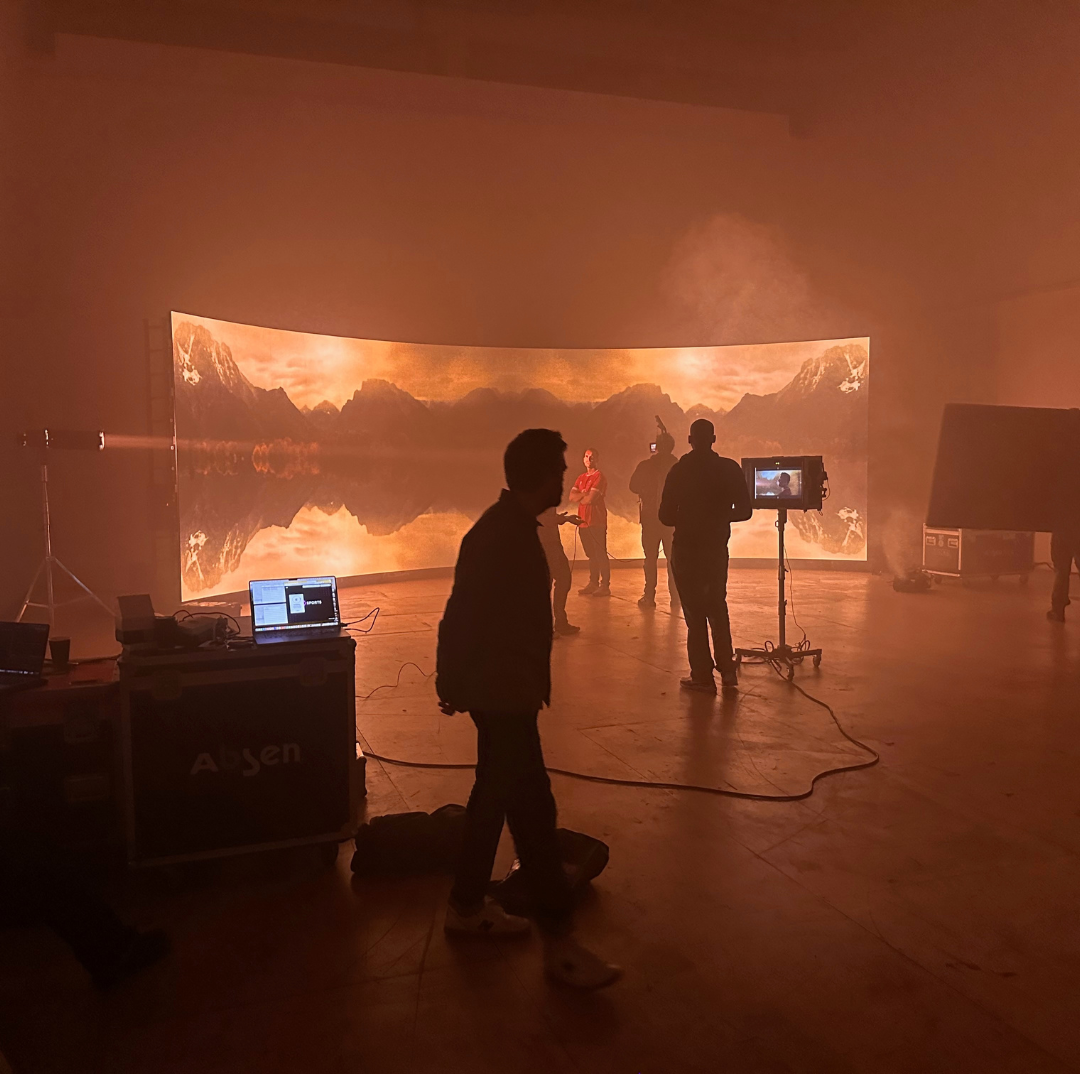
While no one can be sure of the future, we’re regularly party to the capabilities of virtual production here at Sugar Studios, and our thoughts are this:

AI will change many jobs in film and TV production, but it won’t replace human creativity. Instead, AI is and will continue to redefine roles in ways that may ultimately expand opportunities – if studios and artists adapt to the shift.
WHERE AI IS ALREADY MAKING WAVES IN VIRTUAL WORLDS

AI exploded in 2022 with the launch of ChatGPT, but it took a while for it to catch up to the film industry. Now, however, AI tools are used far and wide and have already been integrated into parts of the VFX pipeline. Platforms specialising in relighting footage via machine learning or generating assets for pre-visualisation, for example, are being used in studios around the world.

These tools can drastically reduce the time spent on tasks that previously required hours of manual work (like splitting lighting components or creating preliminary backgrounds). Innovators like Beeble AI are also developing systems that turn 2D footage into relightable 3D assets, speeding up workflows without eliminating artistic decision-making.

Generative and machine-learning technologies are particularly useful and effective for routine, repetitive tasks like rotoscoping, denoising, basic asset generation, and iterative look development. Those tools, which can save many human hours of work, are increasingly common in larger VFX houses and real-time virtual production workflows. And no surprise here – many studios report improved efficiency as a result.

This trend isn’t limited to experimental tools, either. For example, Netflix revealed that it used generative AI for a complex visual effect in the sci-fi series El Eternauta, completing the shot about 10x faster and at a fraction of the cost compared to traditional VFX tools and workflows.

Netflix Co-CEO Ted Sarandos described this not as a threat, but as an opportunity to do more ambitious storytelling within constrained budgets.

WHAT INDUSTRY LEADERS ARE SAYING ABOUT AI

Conversations within the VFX community indicate that AI is reshaping workflows, but human expertise remains central.

In a roundtable hosted by VFX Voice, industry leaders from companies like Digital Domain and DNEG emphasised that AI shouldn’t be seen as a replacement for artists, but as an opportunity to accelerate time-consuming tasks so humans can focus on creativity.

There are numerous voices across the sector that are stressing the importance of continuous learning and adaptation to AI to stay fully relevant in the field.

Paul Salvini, Global CTO of DNEG, put it succinctly: “Our collective job of developing and bringing great stories to life remains unchanged. However, as our tools improve, we can dedicate more time to creative endeavours and less on mundane tasks.”

Similarly, industry founder Mathieu Raynault, CEO of Raynault VFX, notes that while AI will surely reshape pipelines, the fundamental human elements of artistic judgment remain critical. He emphasises that improvement in workflows requires artists and companies to embrace technology while preserving core expertise.

VOICES FROM THE VFX TRENCHES

Of course, our industry leaders do the leading, but it’s not just executives who see the mixed picture. In online forums like Reddit’s VFX community, many VFX professionals share similar views.

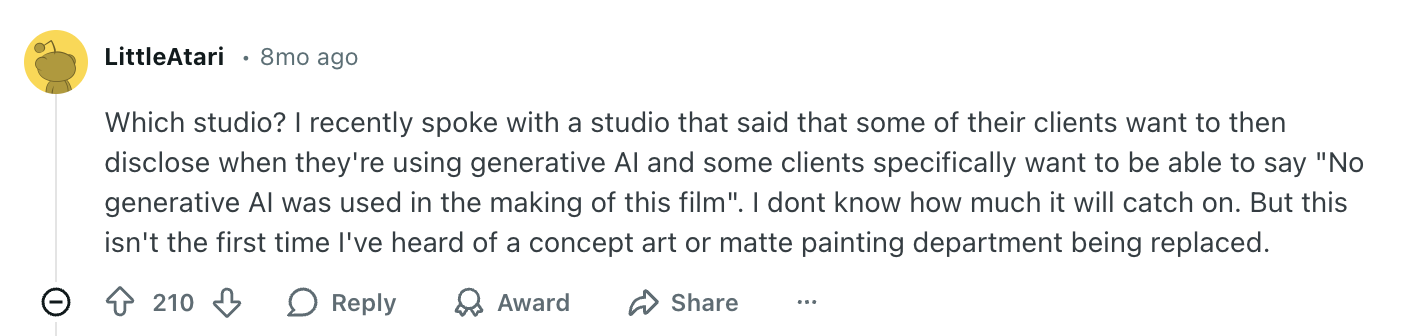
One experienced artist recently shared that their studio’s concept art team had been replaced by AI, which got an interesting conversation going. Another industry insider responded that they’d noticed that “some clients specifically want to be able to say “No generative AI was used in the making of this film””:

Screenshot of post from Reddit user LittleAtari - the text reads "Which studio? I recently spoke with a studio that said that some of their clients want to then disclose when they're using generative AI and some clients specifically want to be able to say "No generative AI was used in the making of this film". I dont know how much it will catch on. But this isn't the first time I've heard of a concept art or matte painting department being replaced."

While another artist piped up that “translating AI concept art to a workable design was insane, because AI often makes impossible structures that look nice, but cannot work in a 3D environment”.

In other words, AI may dramatically reduce the time required for certain tasks, which often increases the volume of work artists are expected to manage – but it doesn’t eliminate their role entirely. Not if the studio wants two arms and two legs on every individual in the shot.

Another community member pointed out a practical reality: AI tools often lack the nuanced control required to meet specific creative notes. For example, asking a tool to adjust contrast on one object while preserving the rest of a shot (something relatively easy for an artist) is still a challenge for AI. So human judgment and refinement are still needed in many parts of the pipeline.

JOBS CHANGE, BUT CREATIVE PROBLEM-SOLVING STAYS HUMAN

There’s no denying that AI is reshaping the nature of work in VFX and virtual production. Tools can automate mundane tasks, and in doing so, change how teams need to be structured. Roles centred purely on repetitive, tool-based output may shift, transform, or, in some cases, contract.

But there’s a critical distinction to make here: technological transformation does not mean wholesale job loss. Historically, advances in technology, from digital compositing to real-time rendering, have altered the work artists do without eliminating the need for artists themselves. The difference now is that AI heightens this trend; it democratises access to tools and enables groups of creators to do, with a small team, what once required a much larger one – but it doesn’t make the creative vision obsolete.

That sentiment is echoed by those already working at the intersection of VP and emerging tech. As Anna Doublet, Virtual Production Business Development Manager at Sony, told us, when researching an article we wrote for Women’s Tech Hub, “When it comes to AI, I believe its real value lies not in replacing creativity, but in enhancing workflows and efficiency of process.”

Another perspective from the Reddit VFX community captures this tension succinctly: AI won’t replace jobs as long as it depends on human creativity and oversight, and the future belongs to those who can steer AI as a tool, not hand over their craft to it.

A POSITIVE OUTLOOK: MORE WORK..?

One of the most encouraging predictions from industry leaders is that rather than shrinking the field, AI expands the volume of work and broadens creative participation. By lowering the time and cost barriers for complex visuals, AI tools make ambitious projects feasible for smaller teams and independent creators – potentially growing the market for VFX and virtual production work overall.

This trend mirrors broader shifts in tech: when tools make specialised tasks easier, they often create new kinds of jobs and fresh forms of creative expression, rather than simply eliminating roles.

Here’s what Joanna Alpe, CCO of Bild Studios and MARS Volume, told us she expects:

“Workflows will continue to standardise, and VP will only become a more frequent and trusted technique for productions everywhere… Next-generation innovations will make it more accessible and affordable for productions of all shapes and sizes.”

OUR VOTE GOES TO HUMAN CREATIVITY MATTERING MOST

AI is reshaping VFX and virtual production, and that’s not going away – nor should it. But what’s also clear is that AI doesn’t replace humans; it augments them (yes, we know, it sounds like they’re turning us into the machines, but you get it). It accelerates workflows, increases creative bandwidth, and expands storytelling possibilities.

The tools evolve. The industry evolves. But the essence of what makes great visual effects – the artistic intuition, the creative problem-solving, the narrative vision – can only ever be human.

There will be fewer rote tasks, and some jobs will change. But as long as there’s a need to tell compelling stories and visualise ideas that resonate with audiences, there will be a need for people. And in many ways, AI helps make that possibility even more achievable for a wider range of creators.

Want to know more? Take a look at our Virtual Production Studio.